, ČR – Evropské centrum mládeže Břeclav_files/ganesa-logo.svg)
, ČR – Evropské centrum mládeže Břeclav_files/69f80e7861aa01513064c2d3b0e445b0.jpg)
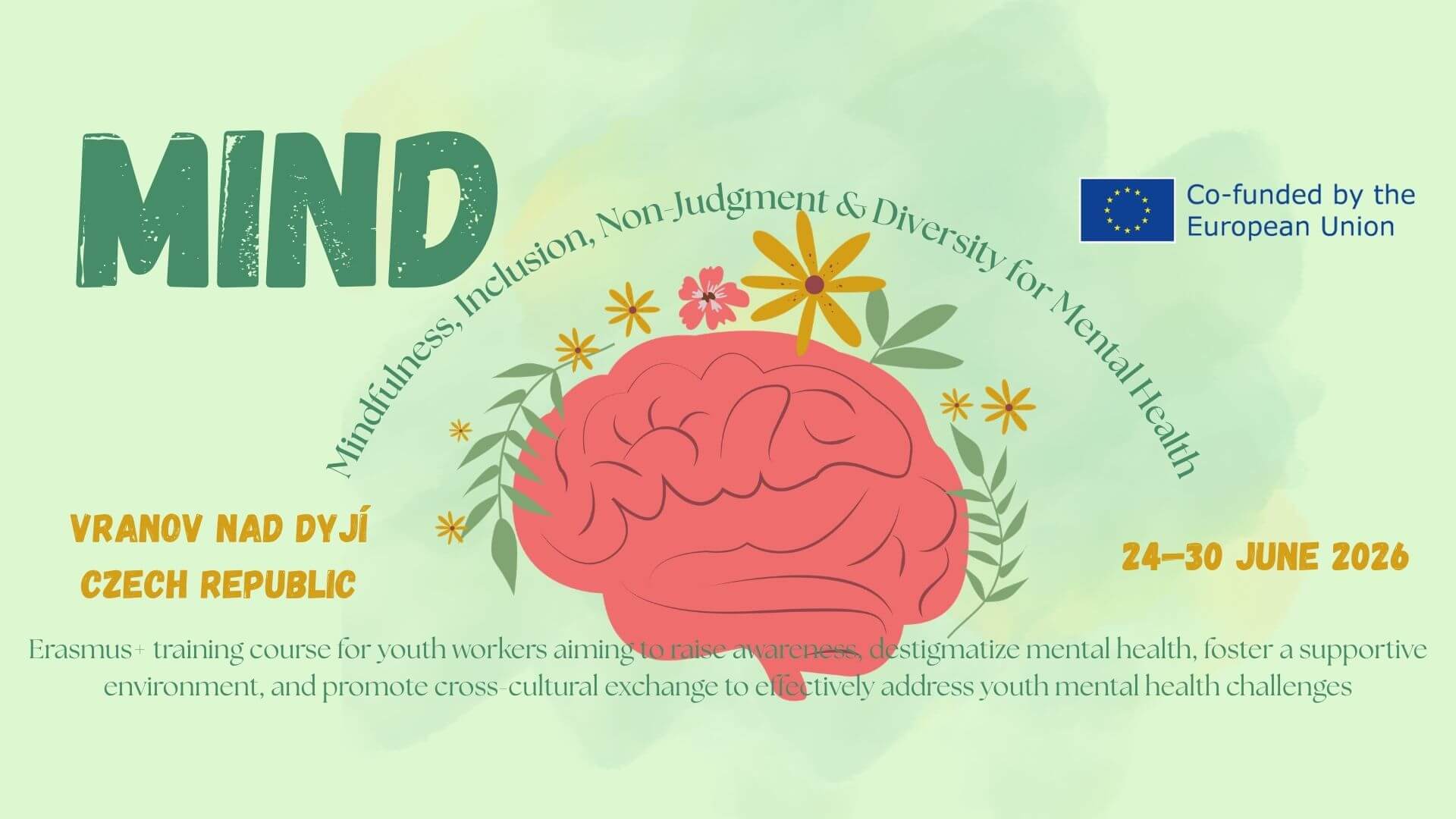
Erasmus+, Key Action (Small-scale partnership).
Activities:
- MIND Booklet
- Training course: 24—30 June 2026, venue: Vranov nad Dyjí, Czech Republic, attended by6 participants(youth workers) from each national team. For more information, please read the info-/travel-pack
- Podcasts (please see below)
- Retreat: 8-10 October 2026, Enying, Hungary. The full day retreat will take place on 9th October 2026.
Partners: European Youth Centre Břeclav (EYCB, Czech Republic), Udruga Better Me (Croatia), NaturKultur e.V. (Germany), Európa Ifjúsága Egyesület (Hungary)
Podcasts:
Podcast 1 – Introduction to MIND
Podcast 2 – Mind Meditation
Podcast 3 – Spirituality
Podcast 4 – Youth Work
Podcast 5 – Evaluation
You can find all of our podcasts episodes also on Audible, and Spotify:
- Podcast 1 – Introduction to Mind
- Podcast series 2 – Mind Meditation
- Podcast series 3 – Spirituality
- Podcast series 4 – Youth Work
- Podcast series 5 – Evaluation
and on Apple:
- Podcast 1 – Introduction to Mind
- Podcast series 2 – Mind Meditation
- Podcast series 3 – Spirituality
- Podcast series 4 – Youth Work
- Podcast series 5 – Evaluation
Project description:
By implementing the project, our main objectives are to destigmatize mental health, empower youth workers, provide tangible solutions, and facilitate collaboration. We aim to raise awareness, enhance skills, foster a supportive environment, and promote cross-cultural exchange to effectively address mental health challenges among European youth. Additionally, we strive to increase youth employability, ensure LGBTQIA+ inclusion, and alleviate stress related to post-Covid and the war in Ukraine.
Impact
The MIND project aims to enhance youth workers‘ skills in mindfulness, inclusion, non-judgment, and diversity for mental health. Expected results include improved mental health support for youth, practical tools for youth workers, increased collaboration among organizations, and the creation of a comprehensive MIND booklet, podcast and other audio resources. The project will foster long-term partnerships, promote inclusivity, and empower youth to address mental health challenges.
The MIND for mental health training course aims to elevate the expertise of youth workers in the realm of mental health through innovative non-formal approaches. Rooted in the principles of mindfulness, integration, non-discrimination, and diversity, this training course seeks to equip youth workers with practical skills to effectively engage and empower youth workers and the youth they work with as active citizens.
The content of the training course is designed to encompass a broad spectrum of topics pertinent to MIND for mental health:
- Introduction to MIND for mental health: The overview of topics such as mindfulness, integration, inclusion, non-judgment, non-discrimination, diversity, mental health, European citizenships and employability, contextualizing these concepts within the framework of mental well-being.
- Non-formal education methods: Innovative approaches to integrate these principles into youth work, employing interactive activities, role-plays, and simulations to enhance engagement and comprehension.
- Designing MIND for mental health programs: Participants will receive guidance on setting clear learning objectives, developing comprehensive lesson plans, and evaluating program outcomes, ensuring the efficacy and impact of their initiatives.
- Additionally, emphasis will be placed on dissemination strategies, equipping participants with the tools to engage young people in mental health activities beyond the scope of the project.
- Dissemination activities: Specific strategies for engaging young people in activities for mental health that will be implemented in each country after the end of the project.
- Diversity, inclusion, and intercultural competence: Strategies to foster an inclusive environment within mental health programs. Participants will learn how to promote diversity and empower marginalized groups, ensuring that all young people have access to and benefit from these initiatives.
Objectives:
The training course aims to enhance the capabilities of youth workers in providing impactful non-formal education on mental health to young individuals, particularly those from underrepresented demographics. This course aligns with several key objectives of the MIND for mental health project, including:
- Creating innovative resources: The training will equip youth workers with practical tools and skills to deliver mental health education through engaging non-formal activities. These resources can be openly shared among youth workers, fostering collaboration and dissemination.
- Facilitating best practices exchange: By bringing together youth workers from diverse backgrounds and countries, the training will provide a platform for sharing and exchanging effective strategies and approaches in youth work and non-formal education.
- Addressing education challenges: In the light of current global events such as the Coronavirus pandemic and conflicts like the war in the Ukraine, the training will empower youth workers with adaptable skills to address evolving education and training needs.
- Cultivating partnerships: Through the collaboration of youth workers from various organizations and nations, the training course will foster partnership-building and pave the way for future initiatives in mental health education across Europe.
- Overall, this training course contributes to the overarching project goal of innovating mental health education methods and nurturing European citizenship among young people and enhancing their employability. By building the capacity of youth workers to deliver effective educational techniques, the training course empowers them to advocate for the European ideal and to influence decision-making processes, even at the local level.
Expected results:
The anticipated outcomes:
- Development of novel methodologies, resources, and approaches in MIND for mental health, fostering European citizenship among the youth in Europe.
- Creation of innovative open-source digital tools and inclusive methodologies for MIND for mental health.
- Facilitation of the exchange of best practices in youth work and non-formal education.
- Strengthening the capacities of youth organizations to address present and future education and training challenges, including those arising from the Coronavirus epidemic, war in Ukraine, working with individuals from LGBTQIA+ community, etc.
- Enhancement of youth workers’ skills through practical training in MIND for mental health via non-formal activities.
- Promotion of European citizenship and the cultivation of competences, boosting the employability of youth individuals.
- Establishment of partnerships and the initiation of fresh initiatives for MIND for mental health throughout Europe.
- Heightening awareness among young people, particularly those in rural areas, regarding opportunities provided by the EU.
- Encouragement of active citizenship among young individuals by equipping them with essential knowledge and skills for personal growth.
- Strengthening and expanding the existing partnership into a pan-European network dedicated to advancing projects in the youth sector. Encouraging youth engagement in public life, fostering innovative practices and tools for youth work.
- Reinforcement of initiative-taking among young people, especially those from underrepresented demographics.
- Establishment of a pan-European coalition of interested organizations committed to spearheading further projects in the youth sector.
- This activity aims to empower young individuals to actively engage as citizens by equipping them with knowledge, skills, and resources to participate meaningfully in MIND for mental health endeavors, both locally and on the European stage.
Training course (24—30 June 2026, Vranov nad Dyjí, Czech Republic) participants‘ report:

Funded by the European Union. Views and opinions expressed are however those of the author(s) only and do not necessarily reflect those of the European Union or the Czech National Agency for International Education and Research (DZS). Neither the European Union nor DZS can be held responsible for them.